









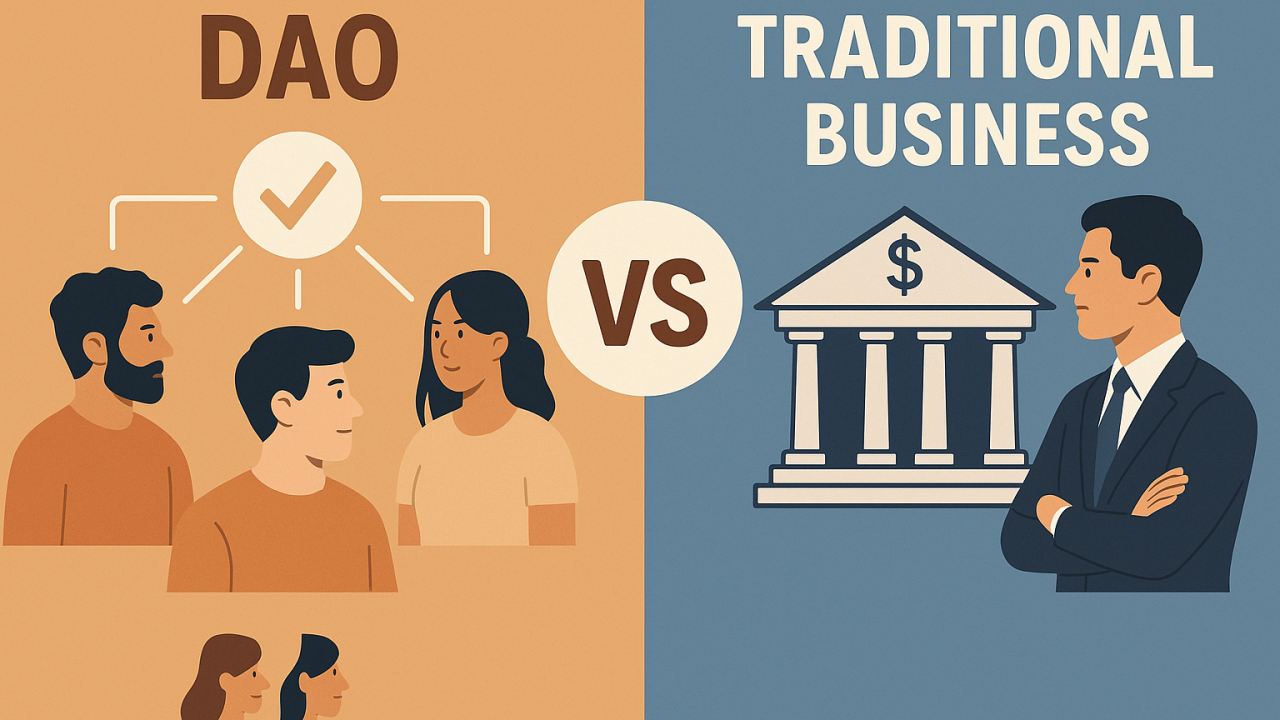
How we organize, govern, and grow businesses is undergoing a seismic shift. With the rise of blockchain technology, a Decentralized Autonomous Organization (DAO) has emerged as an alternative to traditional corporate structures. But how does a DAO compare to a traditional organization? And what makes it different in terms of control, governance, and operations?
In this post, we break down the key differences between DAOs and traditional organizations to help you understand the implications of this evolving model.
What Is a DAO?
Before comparing, let’s clarify: What is a DAO?
A DAO (Decentralized Autonomous Organization) is a blockchain-based entity governed by smart contracts and its community of token holders rather than a centralized management team. DAOs rely on code and consensus instead of executives and legal frameworks. Members propose and vote on changes collectively, making decisions more democratic and transparent.
In contrast, traditional organizations are centralized entities with hierarchical leadership, formal legal structures, and regulated financial systems.
- Governance Structure
Traditional Organizations: Governance in a conventional organization follows a top-down hierarchy and using systems like ERPs. Decisions are made by executives or a board of directors, and employees follow set policies and procedures. Shareholders may vote on high-level issues, but everyday choices typically remain centralized.
DAOs: DAOs operate on decentralized governance. Token holders propose and vote on all organizational decisions—from funding new projects to updating protocols. Smart contracts automate the implementation of approved proposals, ensuring transparency and accountability.
Key Difference: In DAOs, power is distributed among participants. In traditional structures, power is concentrated in leadership.
- Decision-Making Process
Traditional Organizations: Decisions can take weeks or months, moving through layers of management, legal review, and internal approvals. There’s often a lack of transparency in how and why decisions are made.
DAOs: Decisions are proposed and voted on in the open. A community vote determines whether the proposal moves forward. The entire process—from proposal to execution—is recorded on the blockchain for public viewing.
Key Difference: DAOs streamline decision-making through collective voting and automation, while traditional firms rely on hierarchical processes and manual approvals.
- Ownership and Participation
Traditional Organizations: Ownership is usually tied to shares or equity, and access to influence often requires capital or seniority. Employees typically don’t have a say unless they hold significant equity.
DAOs: In DAOs, ownership is tied to governance tokens, which can be earned, purchased, or distributed based on contributions. Every token holder, regardless of status, has the opportunity to vote and participate in governance.
Key Difference: DAOs democratize ownership and influence, while traditional models tend to reserve control for top stakeholders.
- Transparency
Traditional Organizations: Operations, budgets, and decision-making processes are often kept behind closed doors. Transparency is limited, and stakeholders rely on quarterly reports or disclosures for information.
DAOs: Everything—from the treasury balance to the vote history- is recorded on the blockchain and publicly visible. This radical transparency builds trust and reduces opportunities for mismanagement.
Key Difference: DAOs are fully transparent by design, while traditional organizations typically operate in silos.
- Legal and Regulatory Frameworks
Traditional Organizations: Traditional businesses are registered under legal jurisdictions and must comply with national or regional laws. They rely on legal contracts and are governed by regulatory agencies.
DAOs: DAOs exist natively on the blockchain and operate without a central legal entity. While this offers flexibility, it also creates regulatory uncertainty in many jurisdictions. Some DAOs are exploring hybrid models with legal wrappers for compliance.
Key Difference: Traditional organizations operate within defined legal systems, while DAOs challenge conventional boundaries and often operate in legal gray areas.
- Financial Management
Traditional Organizations: Financial transactions are handled through banks and accounting systems. Budget approvals and expense tracking are controlled internally.
DAOs: Treasuries are managed on-chain with crypto wallets. Funds are disbursed automatically based on smart contract logic and community votes. Budget proposals are public and subject to collective approval.
Key Difference: DAOs offer open, real-time financial transparency, whereas traditional organizations typically limit access to economic data.
- Speed and Flexibility
Traditional Organizations: Change can be slow, especially in large companies with complex structures and bureaucracy. Adapting to market changes often requires top-level approval and formal processes.
DAOs: Because of their flat structure and automated systems, DAOs can quickly respond to community needs. New initiatives can be launched with a single vote, giving them an edge in adaptability.
Key Difference: DAOs are inherently agile, while traditional organizations may struggle with inertia.
When Should You Choose a DAO?
While DAOs offer many advantages, such as transparency, inclusivity, and automation, they’re not suited for every situation. They’re ideal for projects that benefit from open governance, community collaboration, and decentralized control (like open-source platforms, DeFi protocols, and digital collectives).
However, industries requiring tight regulatory compliance, physical infrastructure, or centralized authority may still find traditional structures more practical.
Conclusion
The rise of DAOs signals a fundamental rethinking of how organizations are built and run. By removing centralized authority and replacing it with code-based governance and community-driven decision-making, DAOs promise a more democratic and transparent alternative to the traditional corporate model.
Understanding what is a DAO and how it compares to conventional organizations is critical for anyone interested in the future of work, governance, and digital ownership. While DAOs are still evolving, their potential to reshape the global economy is hard to ignore.
Whether you’re exploring decentralized models for a new project or rethinking how your current organization could be more open, DAOs offer a compelling vision of what’s possible when technology and community come together.
READ ALSO: Master of Science in Data Science: Skills, Courses, and Career Opportunities