









Introduction
In high-speed automated production lines or heavy-duty machinery, subtle anomalies in the drivetrain — persistent noise, unexplained vibration, or premature gear wear — are often the “silent killers” of systemic efficiency. These failures not only lead to energy waste (efficiency losses up to 15%) but also trigger unplanned downtime, causing thousands of dollars in production losses per hour and severely eroding profits and brand reputation. The root cause is often mistakenly attributed to a single component or lubrication. In reality, it exposes a fundamental “fracture” in traditional gear manufacturing, where material selection, heat treatment, precision machining, and the final application are treated in isolation. This fragmented, “divide and conquer” approach prevents the gear from being optimized as an integrated part of a system, leading to performance degradation under real-world conditions.
This article outlines a “Systematized Gear Engineering” methodology. This approach treats a gear as a precision system transmitting power, information (like vibration spectra), and reliability. By integrating materials science, micro-geometric control, and a digital quality thread, it ensures predictable transmission efficiency, noise performance, and service life from the outset. This transforms gear manufacturing from a cost center into a core driver of value and operational efficiency. The following sections deconstruct the four pillars of this systematic method, revealing how it translates an “excellent blueprint” into “exceptional performance.”
Why Do Gears That “Pass Inspection” Still Cause Systemic Failures? Decoding the Gap Between Spec and Performance.
This section analyzes common failure modes where gears pass dimensional checks but cause system-level issues, highlighting the critical gap between static conformance to a drawing and dynamic performance in application.
1. The Dimensional Mirage: Passing the Check, Failing the Test
A gear can pass all dimensional and runout inspections yet be a source of systemic failure. Consider a helical gear that meets all print tolerances but causes excessive noise. The root cause may not be a measured dimension but the micro-surface texture left by grinding. An unfavorable texture direction can hinder the formation of a stable oil film, leading to increased friction, heat, and noise — a problem invisible to a standard pin measurement but catastrophic for performance.
2. The Hidden Stress State: A Post-Process Variable
Another invisible culprit is the residual stress state induced by heat treatment and finishing. Improper processes can leave subsurface tensile stresses, creating perfect initiation sites for micro-pitting and fatigue cracks under cyclic loading. The gear is dimensionally “good” but materially compromised, destined for a shortened life and potential unplanned downtime. True quality is defined by performance under target operating conditions, not just by static dimensional compliance.
3. Bridging the Intent-Performance Gap
A gear drawing, defined by standards like ASME Y14.5, establishes the permissible geometric boundaries. However, it is the starting point, not the guarantee of functional success. The journey from print to performance requires deep process understanding to control the variables — surface integrity, stress state, micro-geometry — that the drawing cannot fully specify. To comprehensively understand the framework for backtracking from performance goals to manufacturing decisions, this in-depth guide on gear manufacturing provides a valuable roadmap.
How Can Material Science Predict a Gear’s Lifetime Before It’s Even Cut?
This section explores the predictive power of material science in gear engineering, arguing that advanced material selection and processing are investments in predictable longevity and system reliability.
1. The Cleanliness Advantage: Fighting Fatigue at the Atomic Level
Fatigue failure often starts at microscopic non-metallic inclusions within the steel. Choosing a standard gear steel versus a vacuum-degassed, clean steel can mean the difference between a gear that fails at 100,000 cycles and one that lasts for 10 million. The cleaner steel has far fewer and smaller inclusions, dramatically delaying the initiation of fatigue cracks. This material choice directly translates to a steeper, more favorable stress-life (S-N) curve, offering a quantifiable improvement in predicted service life.
2. The Case for Alloying and Processing Science
Material science extends beyond cleanliness. Specific alloying elements like nickel, chromium, and molybdenum enhance hardenability and core toughness. The precise control of the carburizing process — determining case depth, carbon gradient, and retained austenite levels — is a science in itself. Optimal processing creates a hard, wear-resistant surface married to a tough, fatigue-resistant core. Data on these relationships, extensively documented in resources like the ASM International Handbook on alloy steel fatigue and fracture, enables a shift from experiential “this steel works” to data-driven “this steel and process will achieve our target B10 life.”
3. Material as a System Input, Not a Commodity
In systematized gear engineering, material is not a purchased commodity but a designed-in system input. The material specification, including its cleanliness rating (e.g., per ASTM E45), heat treatment curve, and final hardness profile, is selected based on the specific load spectrum, desired efficiency, and lifecycle cost targets. This scientific approach transforms material cost from an expense into an investment in predictable performance and durability.
Is “Precision” About the Machine, or the Control of the Process?
This section redefines precision in gear manufacturing, arguing that it is an output of a statistically controlled process, not merely a capability of an advanced machine, and is essential for supply chain reliability.
1. The Machine is the Tool, The Process is the Craftsman
Owning a state-of-the-art gear grinding machine does not guarantee precision. Precision is the consistent, repeatable output of a controlled system. A machine can produce a perfect gear once; a controlled process produces ten thousand identical ones. The difference lies in the surrounding ecosystem of measurement, feedback, and adjustment that compensates for variables like tool wear, thermal drift, and material lot differences.
2. Statistical Process Control: The Guardian of Consistency
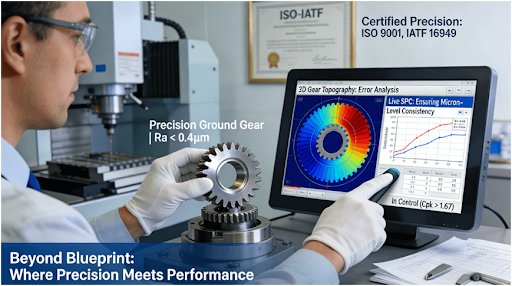
True precision is enforced through Statistical Process Control (SPC). In gear manufacturing, this means real-time monitoring of tooth profile and lead deviation on the production line. Control charts track these critical characteristics, triggering alerts if the process shows signs of drifting out of statistical control — long before it produces a single out-of-spec part. This ensures that every gear, from the first to the ten-thousandth, carries an identical “performance signature” for noise and efficiency.
3. Certification as a Proxy for Systemic Control
Adherence to advanced quality management systems like IATF 16949 institutionalizes this process control mindset. Such standards mandate documented control plans, rigorous Production Part Approval Processes (PPAP), and the use of SPC. They transform precision from an artisanal outcome into a standardized, auditable, and scalable output. This is the non-negotiable foundation for supply chain reliability in sectors like automotive, where a single faulty gear can halt an entire assembly line.
How Does a “Digital Twin” of the Gear Prevent Costly Physical Trials?
This section details the application of digital twin technology in gear development, explaining how simulation models predict performance and optimize design virtually, drastically reducing the need for physical prototypes.
1. Virtual Stress and Deformation Analysis: Long before a steel blank is cut, a gear’s digital twin can be subjected to simulated loads. Finite Element Analysis (FEA) models calculate the stress distribution across tooth flanks and roots under maximum torque, identifying potential overstress zones. It can also simulate the elastic deformation of the gear body and shafts under load. This allows engineers to proactively reinforce weak areas or optimize the gear web design for stiffness and weight, preventing failures that would only be discovered in costly physical testing.
2. Predicting Noise and Vibration (NVH) Spectra: Noise is a primary performance metric. Multi-Body Dynamics (MBD) simulation models the entire gear pair or planetary set within its housing. It calculates the transmission error — the primary excitation for gear whine — across the entire operating speed range. Engineers can then iteratively apply and test different micro-geometry modifications (profile crowning, tip relief) in the digital environment to find the combination that minimizes transmission error and predicts the optimal NVH performance, turning noise reduction from a trial-and-error process into a predictive science.
3. Accelerating Development and De-risking Design: This virtual validation loop compresses development cycles by months. It allows for the exploration of radical design alternatives without the cost and delay of physical prototypes. Potential meshing issues, resonance frequencies, and stress concentrations are identified and resolved digitally. Therefore, seamlessly translating a digitally optimized design into a reliable physical part requires close collaboration with a gear machining service china partner possessing comprehensive engineering capabilities to bridge the virtual and physical worlds.
From Unit Cost to Total Cost of Ownership: A New Lens for Gear Procurement.
This final section provides a framework for Total Cost of Ownership (TCO) analysis in gear procurement, arguing that the lowest unit price often leads to the highest lifetime cost when downtime and failure risks are accounted for.
1. Deconstructing the “True” Cost of a Gear
The purchase price is a small fraction of a gear’s TCO. The real cost includes:
l Cost of Failure: The price of the replacement gear, plus the labor to install it.
l Cost of Downtime: The lost production revenue per hour the machine is idle. This can dwarf the gear’s cost.
l Cost of Inefficiency: The ongoing energy waste from a poorly manufactured, inefficient gear.
A gear with a 20% higher unit price but a 50% longer lifespan and 5% higher efficiency represents a dramatically lower TCO.
2. The Value of a Data-Backed “Premium”
A premium gear comes with a preventive data package: material certifications, SPC reports from production, and a full inspection report with deviation plots. This data is not an added cost; it is risk mitigation. It provides evidence of the gear’s integrity and the stability of the process that made it. It allows you to predict performance and plan maintenance, transforming procurement from a commodity purchase into a strategic partnership for operational reliability.
3. Making the Strategic Calculation
Procurement decisions must be informed by calculating the Hourly Cost of Downtime (HCD). If a gear failure stops a line costing $10,000 per hour, even a small reduction in failure risk justifies a significant investment in proven quality and data transparency. Evaluating suppliers through this TCO lens naturally prioritizes those with robust engineering and quality systems over those competing solely on the lowest unit cost.
Conclusion
In the pursuit of ultimate efficiency and reliability in modern industry, the gear has transcended its identity as a mere mechanical component. It has become a critical system element bearing performance promises, efficiency data, and risk mitigation strategy. By embracing “Systematized Gear Engineering” — which fuses materials science, digital process control, and total lifecycle cost analysis — companies can transform their drivetrains from potential failure points and cost sinks into predictable, efficient, and resilient value creators. This is not merely a technical upgrade; it is a strategic revolution in supply chain thinking.
FAQs
Q: What’s the most important factor in choosing a gear type for a new application?
A: The primary driver is the application’s priority. For high-speed, high-power, and quiet operation (e.g., EV transmissions), helical gears are superior due to smooth engagement. For high-ratio reduction in compact spaces, worm gears are ideal despite lower efficiency. The choice balances efficiency, noise, load, speed, and spatial constraints.
Q: How can we reduce gear noise in an existing machine without a full redesign?
A: Often, noise stems from misalignment or improper meshing. Solutions include precision realignment of shafts and bearings, applying micro-geometry corrections (tip/root relief) to existing gears via precision grinding, and switching to a higher-performance lubricant. A detailed vibration analysis is crucial to identify the exact source.
Q: What should we look for in a gear supplier beyond their equipment list?
A: Focus on their process control evidence. Request sample inspection reports (CMM plots showing profile/lead), material certifications, and SPC charts for a past project. Ask about their heat treatment process control and corrective action system. A supplier’s willingness to share this data speaks volumes about their real capability.
Q: Is it cost-effective to use powder metal (PM) gears for low-volume production?
A: PM is excellent for high-volume, complex-shaped gears with moderate strength. For low volumes, CNC machining from bar stock is often more economical, as it avoids high tooling (die) costs. PM’s cost advantage typically emerges with volumes in the thousands.
Q: What kind of warranty or performance guarantee can a premium gear manufacturer provide?
A: Reputable manufacturers stand behind their process control. They provide warranties against material and workmanship defects. For critical applications, they may offer performance-based agreements backed by data from their rigorous inspection protocols (e.g., guaranteed to meet specific ISO accuracy grades).
Author Bio
The insights in this article are drawn from deep expertise in high-precision transmission component manufacturing and system integration. As a manufacturing partner certified to ISO 9001, IATF 16949, and AS9100D, LS Manufacturing is dedicated to providing full-spectrum gear solutions — from performance simulation and precision manufacturing to batch consistency assurance — through deep technical collaboration. Submit your drivetrain performance requirements or gear drawing today to receive a complimentary preliminary “System Efficiency Potential & Risk Assessment” report.